Decoding BIM Maturity: A Complete Guide to Level of Development (LOD) 100–500
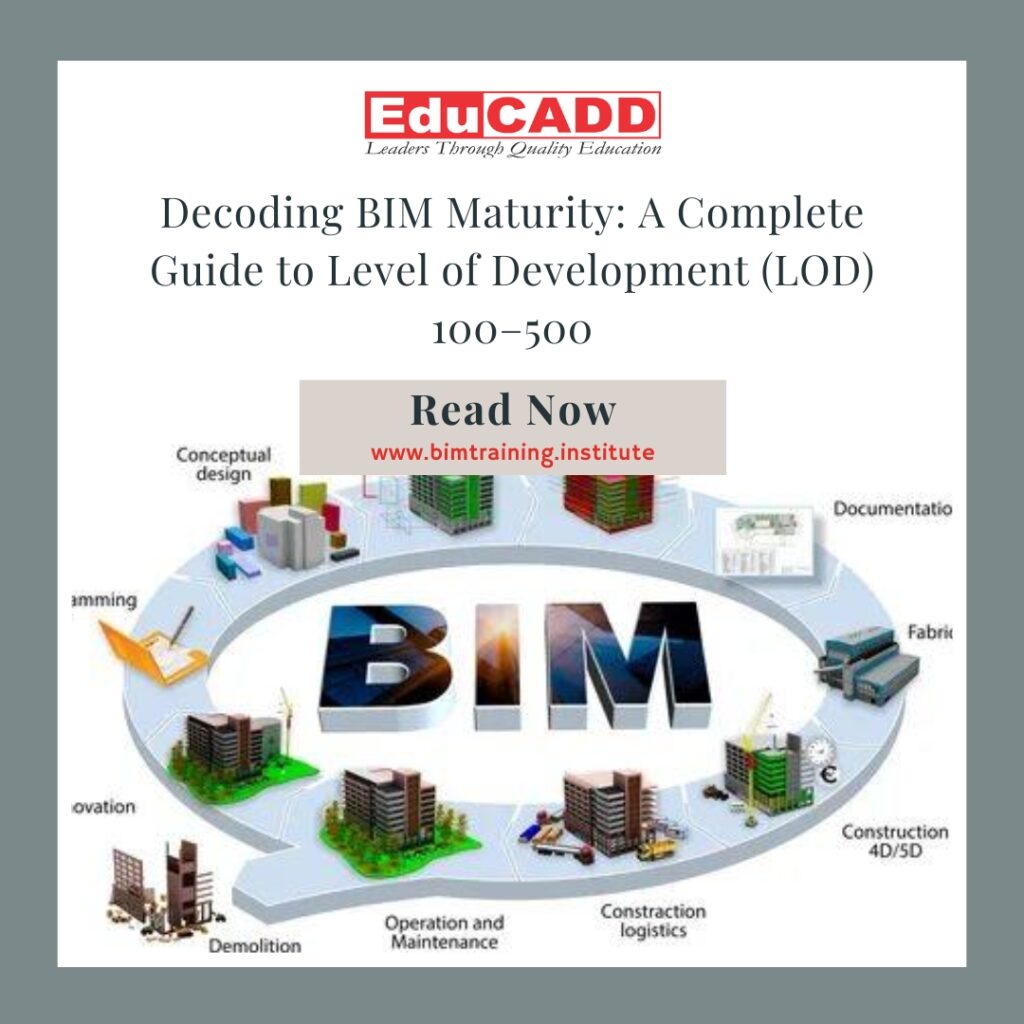
Building Information Modeling has transformed how the AEC industry plans, designs, and delivers projects. However, BIM success depends not only on software or 3D visuals but on clarity of information. This is where BIM Level of Development becomes critical. LOD defines how much detail and reliability a BIM model carries at each project stage. It creates a common language between architects, engineers, contractors, and owners. When teams clearly understand LOD 100 to 500, coordination improves, risks reduce, and decisions become faster. This detailed guide explains every LOD stage in depth, showing how it supports design accuracy, construction efficiency, and lifecycle management.
1. Understanding Level of Development (LOD) in BIM
BIM Level of Development describes the completeness and reliability of model elements at different project phases. It does not simply mean graphical detail. Instead, it defines how trustworthy the information is for decision-making. Each LOD stage communicates what stakeholders can safely assume from the model. This clarity prevents overuse or misuse of BIM data. As projects grow complex, LOD becomes essential for collaboration. It ensures every discipline works with the right expectations. Therefore, LOD acts as a roadmap that aligns BIM deliverables with project goals.
2. The Evolution and Purpose of LOD Standards
The concept of Level of Development in BIM emerged to solve confusion around model accuracy. Early BIM projects suffered from misinterpretation of model data. Industry bodies introduced LOD standards to address this gap. These standards helped teams understand when models are suitable for estimation, coordination, or fabrication. Over time, LOD evolved into a contractual and technical benchmark. Today, it plays a vital role in BIM execution plans. As a result, project accountability has improved across design and construction stages.
3. LOD 100: Conceptual Design and Massing
LOD 100 represents the earliest stage of BIM development. At this level, model elements appear as generic symbols or massing forms. Designers use LOD 100 to explore ideas, building orientation, and spatial relationships. Quantities remain approximate at this stage. However, the model still supports high-level cost studies and feasibility analysis. Because decisions remain flexible, LOD 100 encourages creativity. It sets the foundation for all future BIM development without locking in details too early.
4. LOD 200: Schematic Design with Approximate Systems
LOD 200 introduces defined elements with approximate size, shape, and location. Components such as walls, floors, and systems become recognizable. While details remain generalized, coordination improves significantly. Designers use this level to study system layouts and design intent. Cost estimates also become more reliable. Moreover, LOD 200 helps stakeholders visualize the project better. It bridges the gap between abstract concepts and practical planning.
5. LOD 300: Precise Geometry for Design Coordination
LOD 300 marks a major milestone in Level of Development in BIM. At this stage, model elements carry accurate size, shape, and location. Teams rely on LOD 300 for coordination and clash detection. Engineers and architects collaborate closely to resolve conflicts. Construction documents often derive from this level. Since information accuracy increases, design decisions become more confident. Consequently, errors during construction reduce significantly.
6. LOD 350: Enhanced Interfaces and Connections
LOD 350 expands on LOD 300 by adding detailed interfaces between building systems. This includes connections, supports, and clearances. The focus shifts toward constructability. Contractors benefit greatly from this level. It helps them plan sequencing and installation methods. Additionally, coordination between trades becomes smoother. LOD 350 ensures systems do not merely fit but also function together efficiently.
7. LOD 400: Fabrication and Installation Detail
LOD 400 delivers fabrication-level information. Model elements include precise dimensions, materials, and assembly details. Manufacturers and fabricators rely on this data. Shop drawings often come directly from the BIM model. This level supports off-site prefabrication and reduces rework. Since accuracy peaks here, construction efficiency increases. LOD 400 represents a strong link between digital design and physical construction.
8. LOD 500: As-Built and Facility Management Models
LOD 500 reflects the final, verified condition of the building. It represents what was actually built on site. This level supports operations and facility management. Owners use LOD 500 for maintenance, renovations, and asset tracking. Information accuracy remains extremely high. Unlike earlier stages, LOD 500 focuses on long-term value. It extends BIM benefits beyond construction into the building lifecycle.
9. Comparing LOD 100 to 500: Progressive Information Growth
Each Level of Development in BIM builds upon the previous one. Information grows progressively, not abruptly. LOD 100 focuses on vision, while LOD 500 focuses on reality. Understanding this progression prevents unrealistic expectations. Teams avoid using early models for advanced decisions. This structured growth enhances trust in BIM data. Therefore, LOD comparison highlights the importance of timing in information usage.
10. Role of LOD in BIM Execution Plans (BEP)
A BIM Execution Plan defines how LOD applies to a project. It clarifies responsibilities, deliverables, and timelines. When teams define LOD clearly, collaboration improves. Conflicts reduce because expectations align early. BEPs often specify which discipline reaches which LOD stage. This structured approach ensures smooth workflows. Consequently, project transparency increases across all stakeholders.
11. LOD and Cost Estimation Accuracy
Cost estimation improves significantly with higher LOD levels. Early estimates rely on LOD 100 and 200. Detailed quantities emerge at LOD 300 and beyond. This progressive accuracy helps owners plan budgets effectively. Contractors also benefit from reduced financial risk. As a result, cost overruns decrease. Level of Development in BIM directly supports financial control.
12. LOD in Clash Detection and Risk Reduction
Clash detection relies heavily on accurate model data. LOD 300 and above enable effective coordination. Teams identify conflicts before construction begins. This proactive approach saves time and money. LOD standards also define when clash detection becomes meaningful. By following this process, project risks reduce substantially. BIM becomes a preventive tool rather than a reactive solution.
13. Common Misconceptions About LOD in BIM
Many professionals confuse LOD with visual detail alone. However, information reliability matters more than appearance. Another misconception involves skipping LOD stages. This approach often leads to confusion. Proper understanding of Level of Development in BIM prevents such issues. Education and clear documentation remain essential. Addressing misconceptions strengthens BIM adoption across the industry.
14. Implementing LOD Effectively Across Projects
Successful LOD implementation requires planning and discipline. Teams must agree on definitions early. Software tools should align with LOD goals. Regular reviews ensure consistency. Training also plays a vital role. When teams understand LOD clearly, productivity increases. This structured approach transforms BIM from a tool into a strategy.
Conclusion
BIM Level of Development provides structure, clarity, and confidence throughout a project lifecycle. From LOD 100’s conceptual vision to LOD 500’s as-built reality, each stage adds measurable value. Clear LOD definitions reduce errors, improve collaboration, and enhance decision-making. As BIM adoption grows, understanding LOD becomes essential for every AEC professional. When used correctly, LOD turns BIM into a powerful driver of efficiency, accuracy, and long-term project success.