In today’s competitive construction and design industry, communication defines success. Clients expect more than drawings and technical explanations. They want clarity, confidence, and a compelling vision of the final outcome. This is where Advanced BIM Visualization Techniques become essential. Building Information Modeling has already transformed how professionals design and coordinate projects. However, its visualization capabilities elevate presentations to a completely different level.
When firms use advanced BIM visualization techniques for client presentations, they replace ambiguity with realism. Clients can see spaces, understand materials, and experience scale long before construction begins. As a result, they make faster decisions and trust the process more deeply. Moreover, visualization bridges the gap between technical expertise and non-technical stakeholders. Instead of overwhelming clients with complex drawings, teams deliver immersive experiences that speak directly to their expectations.
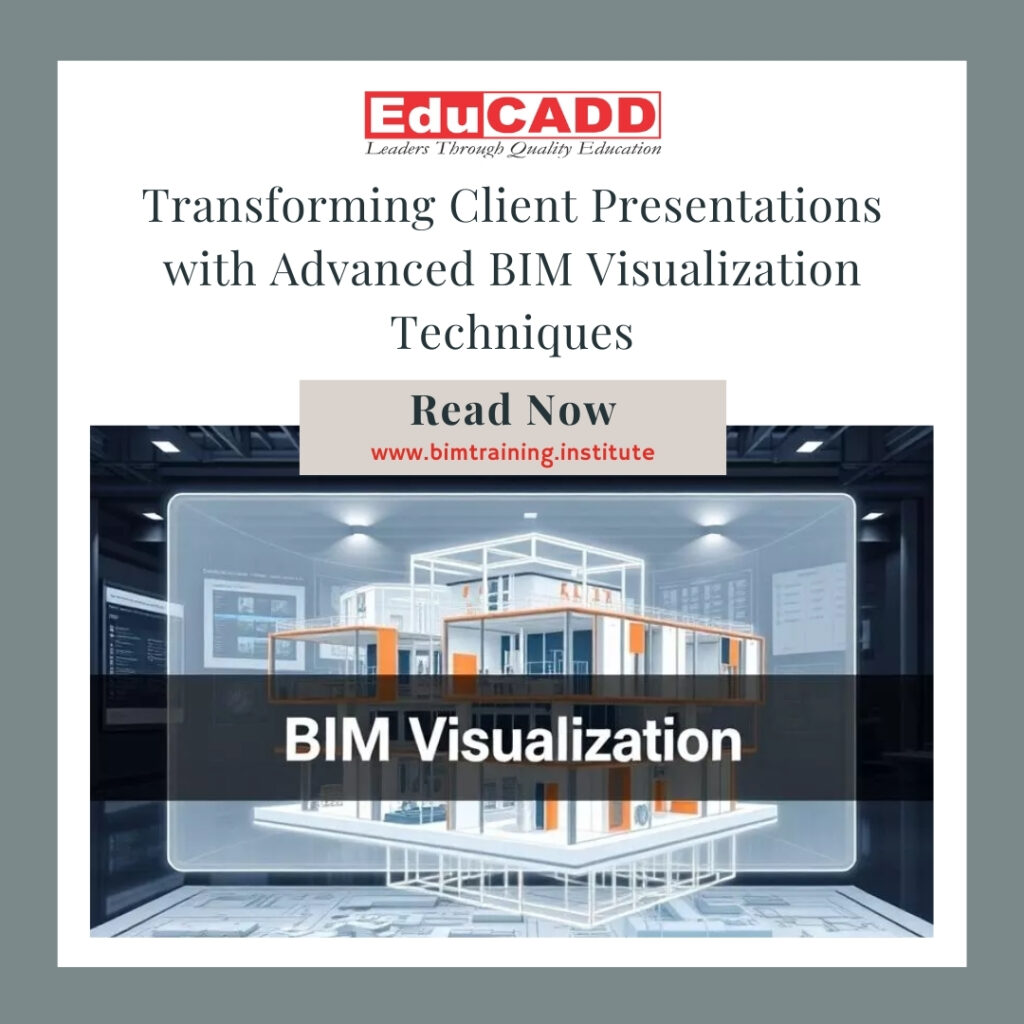
This blog explores powerful BIM visualization techniques for client presentations in detail. It explains practical methods, advanced tools, and strategic approaches that ensure every presentation leaves a lasting impression.
1. The Strategic Importance of BIM Visualization in Modern Presentations
Every successful project begins with clear communication. Traditional 2D drawings often fail to communicate depth, proportion, and spatial relationships. Consequently, clients struggle to visualize the final outcome. In contrast, Advanced BIM Visualization Techniques for client presentations provide dynamic, accurate, and engaging representations of the project.
These techniques allow architects and engineers to present data-rich models with visual clarity. Clients do not need technical knowledge to understand them. Instead, they experience the design in a realistic and interactive format. Furthermore, visualization builds transparency. When clients see how systems integrate within the structure, they develop confidence in the planning process.
Another key advantage lies in decision-making speed. Since BIM visualization techniques for client presentations show real-time modifications, clients can evaluate alternatives instantly. This interactive approach reduces revisions and minimizes misunderstandings. Therefore, visualization not only enhances presentation quality but also strengthens project efficiency.
2. High-Quality 3D Modeling as the Foundation
At the core of BIM visualization techniques for client presentations lies detailed 3D modeling. Without an accurate and structured model, no visualization method can deliver strong results. Hence, professionals must begin with precision modeling.
A well-developed 3D model includes geometry, materials, lighting information, and parametric data. This data forms the base for every visual representation. When teams invest time in creating high-quality models, they unlock endless presentation possibilities. Additionally, accurate modeling ensures that every rendered image reflects real-world dimensions and materials.
Clients respond positively when they observe realistic spatial relationships. For example, ceiling heights, window placements, and corridor widths become easy to understand in 3D space. As a result, BIM visualization techniques for client presentations create confidence through clarity.
3. Photorealistic Rendering for Impactful First Impressions
First impressions matter in client meetings. Photorealistic rendering remains one of the most powerful BIM visualization techniques for client presentations. It transforms digital models into lifelike visuals that resemble finished buildings.
Rendering engines simulate lighting conditions, textures, reflections, and shadows. These elements bring authenticity to the design. Instead of imagining how materials will look, clients see them clearly. Furthermore, realistic lighting conditions demonstrate how spaces behave during different times of the day.
Photorealistic visuals also support marketing objectives. Developers can use rendered images for brochures, websites, and advertisements. Consequently, BIM visualization techniques for client presentations extend beyond meetings and contribute to broader branding strategies.
4. Real-Time Rendering and Interactive Walkthroughs
While static images create impact, interactive experiences generate deeper engagement. Real-time rendering stands among the most effective BIM visualization techniques for client presentations today. It allows clients to navigate the project virtually.
During interactive walkthroughs, clients can move through rooms, explore layouts, and observe finishes from various angles. This dynamic experience increases understanding dramatically. Moreover, real-time rendering enables instant modifications. If a client suggests a design change, teams can update materials or layouts immediately.
Such responsiveness builds trust. Clients appreciate seeing their feedback implemented instantly. Therefore, BIM visualization techniques for client presentations foster collaboration rather than one-sided explanations.
5. Virtual Reality for Immersive Experiences
Virtual Reality has redefined client engagement in recent years. Among all BIM visualization techniques for client presentations, VR offers unmatched immersion. By wearing VR headsets, clients step inside the design.
They can assess scale, spatial comfort, and layout functionality realistically. Unlike screen-based presentations, VR engages multiple senses. Clients feel present within the environment. Consequently, they provide more accurate feedback.
Moreover, VR reduces design uncertainties. When clients walk through a virtual building, they detect layout concerns early. Addressing these concerns during the design phase prevents costly changes later. Thus, BIM visualization techniques for client presentations that include VR significantly improve project outcomes.
6. Augmented Reality for On-Site Visualization
Augmented Reality complements VR by integrating digital models into real-world environments. As one of the innovative BIM visualization techniques for client presentations, AR overlays building models onto physical sites.
During site visits, clients can use tablets or AR glasses to view the proposed structure in its actual location. This technique enhances contextual understanding. Clients evaluate height, massing, and alignment directly on site.
Furthermore, AR helps stakeholders compare design options effectively. They visualize different façade treatments or landscape layouts in real time. Therefore, BIM visualization techniques for client presentations that use AR create practical and engaging demonstrations.
7. 4D Simulation to Demonstrate Construction Phasing
Time-based visualization strengthens client understanding of project timelines. 4D simulation, which integrates scheduling with 3D models, represents another valuable BIM visualization technique for client presentations.
Through animated construction sequences, clients observe how the building develops over time. This approach clarifies project milestones and phasing strategies. Additionally, it builds trust regarding schedule feasibility.
Clients appreciate transparency in timelines. When they see step-by-step construction progress visually, they gain confidence in planning accuracy. Hence, BIM visualization techniques for client presentations that incorporate 4D simulation enhance both clarity and credibility.
8. 5D Visualization for Cost Transparency
Budget concerns often influence client decisions. Integrating cost data with BIM models results in 5D visualization. This method ranks highly among strategic Advanced BIM Visualization Techniques for client presentations.
By linking elements to cost information, teams can show how design changes affect budgets instantly. For example, altering façade materials updates cost projections automatically. Clients understand financial impacts clearly.
This transparency reduces disputes and supports informed decisions. As a result, BIM visualization techniques for client presentations that include 5D modeling improve financial communication and accountability.
9. Animation and Cinematic Presentations
Storytelling enhances emotional connection. Animated sequences represent creative BIM visualization techniques for client presentations that captivate audiences.
Cinematic animations showcase building exteriors, interiors, and landscapes in a fluid narrative. Camera movements simulate drone flyovers or interior tours. Additionally, background music and text overlays create a polished experience.
These presentations work particularly well for investors and public stakeholders. They convey the project vision effectively within a short time. Consequently, BIM visualization techniques for client presentations that use animation strengthen persuasive communication.
10. Data Visualization and Infographics Integration
BIM models contain extensive information. However, raw data often overwhelms clients. Transforming complex data into visual graphics forms another critical BIM visualization technique for client presentations.
Color-coded diagrams illustrate energy performance, structural loads, or ventilation flow. Charts and infographics simplify technical metrics. Clients grasp essential information without confusion.
By integrating data visualization with 3D models, professionals deliver both aesthetics and intelligence. Therefore, BIM visualization techniques for client presentations combine clarity with analytical depth.
11. Lighting and Environmental Simulations
Environmental performance strongly influences design approval. Lighting simulations demonstrate how natural and artificial lighting interact within spaces. These simulations stand among highly practical BIM visualization techniques for client presentations.
Daylight analysis reveals shadow patterns and brightness levels. Clients understand comfort conditions before construction begins. Similarly, energy modeling visualizations highlight sustainability benefits.
Such demonstrations align projects with green building goals. Consequently, BIM visualization techniques for client presentations contribute to environmental transparency and compliance.
12. Cloud-Based Collaboration Platforms
Modern presentations extend beyond meeting rooms. Cloud platforms enhance BIM visualization techniques for client presentations by enabling remote access.
Clients can review models online, explore viewpoints, and leave comments. This accessibility accelerates feedback cycles. Furthermore, cloud-based sharing eliminates version confusion.
Since every stakeholder accesses updated models, communication becomes seamless. Thus, BIM visualization techniques for client presentations gain efficiency through digital collaboration.
13. Customization for Targeted Audiences
Not every client values the same information. Effective BIM visualization techniques for client presentations adapt content to audience needs.
For example, developers may prioritize cost and marketing visuals. Facility managers may focus on maintenance data. Meanwhile, architects might emphasize aesthetics. Tailoring visual content ensures relevance.
When presentations address specific concerns directly, clients remain engaged. Therefore, BIM visualization techniques for client presentations achieve stronger impact through customization.
14. Future Trends Shaping BIM Visualization
Technology continues to evolve rapidly. Artificial Intelligence enhances rendering speed and realism. Cloud computing supports complex simulations. Additionally, digital twins provide real-time operational data.
These advancements expand the possibilities of Advanced BIM Visualization Techniques for client presentations. Future presentations may integrate live performance data into immersive environments. Clients will explore operational buildings before construction even starts.
As innovation accelerates, professionals who adopt emerging technologies will lead the industry. Therefore, continuous learning remains essential for mastering BIM visualization techniques for client presentations.
Conclusion
Advanced BIM Visualization Techniques for client presentations have redefined how professionals communicate design intent. They replace static drawings with immersive experiences, real-time simulations, and data-driven insights. Through photorealistic rendering, virtual reality, augmented reality, 4D scheduling, and 5D cost modeling, teams present projects with clarity and confidence.
Moreover, these techniques improve collaboration, reduce misunderstandings, and accelerate decision-making. Clients feel engaged because they see and experience the design rather than interpret it. As technology advances, BIM visualization techniques for client presentations will become even more powerful and interactive. Firms that embrace these tools will deliver compelling presentations that inspire trust, secure approvals, and strengthen long-term partnerships.