Transforming Construction: The Ultimate End-to-End BIM Project Delivery Workflow
Introduction:
In the modern era of construction and infrastructure development, the need for efficiency, accuracy, and collaboration has never been greater. Traditional methods of design, planning, and execution are increasingly being replaced by technologically advanced solutions that allow teams to work smarter, faster, and with fewer errors. One such transformative approach is the End-to-End BIM Workflow. Building Information Modeling (BIM) has revolutionized how architects, engineers, and construction professionals conceptualize, plan, and execute projects. This workflow integrates all stages of a project from design to operation, ensuring consistency, transparency, and measurable performance improvements. In this blog, we explore the entire BIM workflow in detail, breaking down each phase to illustrate how it maximizes efficiency and reduces risk throughout the project lifecycle.
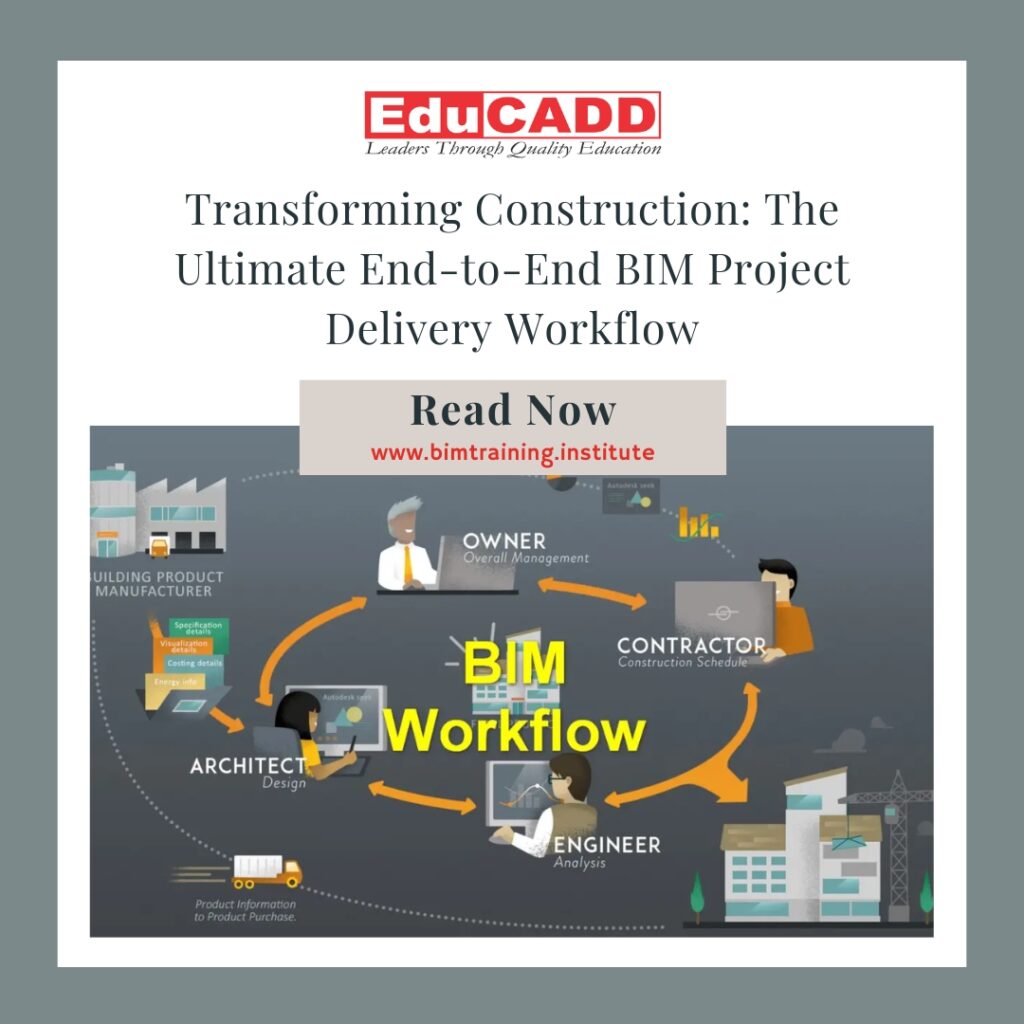
1. Understanding the Fundamentals of BIM
BIM, or Building Information Modeling, is more than just 3D modeling software; it is a comprehensive methodology that integrates design, documentation, and operational data into a unified digital representation. The End-to-End BIM Project Delivery Workflow begins with understanding these fundamentals. Teams must familiarize themselves with BIM standards, protocols, and collaborative practices to ensure consistent data management. At this stage, it is crucial to define project objectives, identify stakeholders, and determine the level of detail required in models, ensuring a strong foundation for subsequent phases.
2. Project Initiation and Feasibility Analysis
The workflow begins with project initiation, where feasibility studies and preliminary assessments are conducted. BIM tools allow teams to visualize potential designs, evaluate site conditions, and perform energy or cost analysis early in the planning stage. Using BIM for feasibility reduces the risk of costly changes later. Accurate simulations and data-driven insights during initiation ensure the project aligns with client goals, regulatory standards, and budget constraints, providing a roadmap for successful delivery.
3. Conceptual Design and Spatial Planning
Once feasibility is established, the conceptual design phase begins. This is where architects and designers use BIM to create initial layouts, massing models, and spatial arrangements. End-to-End BIM Project Delivery Workflow emphasizes collaboration at this stage. Stakeholders can provide feedback directly on the models, allowing for early design validation. Integrating spatial planning with BIM enables conflict detection, energy analysis, and efficient use of resources, ensuring designs are functional and cost-effective from the outset.
4. Detailed Design and Engineering Integration
The transition from conceptual to detailed design involves precise modeling of structural, mechanical, electrical, and plumbing systems. BIM allows for multidisciplinary integration, ensuring all engineering components work together seamlessly. The workflow ensures that clashes between disciplines are identified and resolved early. By incorporating accurate material specifications and construction methods, detailed design using BIM enhances precision and reduces errors during construction, saving time and reducing costs.
5. Coordination and Clash Detection
Clash detection is a critical component of the End-to-End BIM Workflow. As multiple disciplines contribute to the model, conflicts may arise between structural, MEP, and architectural elements. BIM software enables automated clash detection and reporting, allowing project teams to resolve issues before construction begins. This proactive approach minimizes delays, avoids rework, and ensures smooth coordination among contractors, engineers, and designers throughout the project lifecycle.
6. Cost Estimation and Quantity Takeoff
BIM not only supports design and coordination but also enhances cost management. Using the integrated model, project teams can perform accurate quantity takeoffs and estimate costs with greater precision. This phase allows for budget optimization, value engineering, and timely financial planning. The End-to-End BIM Project Delivery Workflow ensures that cost data is linked directly to design changes, maintaining transparency and enabling real-time budget tracking, which significantly reduces financial risks.
7. Construction Planning and Scheduling
Scheduling and construction planning are streamlined through BIM-based workflows. With 4D BIM, time-related aspects of the project, such as sequencing and construction phasing, are visually represented. Project managers can simulate construction activities, identify bottlenecks, and plan resource allocation efficiently. The End-to-End BIM Project Delivery Workflow integrates time and cost data (5D BIM), creating a comprehensive framework that aligns project schedules with budgets and material procurement, ensuring timely project completion.
8. Procurement and Supply Chain Management
An often-overlooked advantage of BIM is its ability to optimize procurement and supply chain management. By linking the model with material specifications, vendors, and delivery schedules, teams can streamline ordering processes. This ensures materials arrive on time and reduce waste. The End-to-End BIM Project Delivery Workflow emphasizes seamless coordination between design, procurement, and construction teams, allowing for just-in-time delivery and efficient resource utilization, thereby improving overall project productivity.
9. Construction Execution and On-Site Management
BIM enhances on-site management by creating a real-time digital twin of the project. Contractors and site engineers access model data on mobile devices, enabling precise placement, monitoring, and verification of construction activities. BIM-enabled workflows improve site inspections, quality checks, and safety compliance. The End-to-End BIM Project Delivery Workflow keeps project execution aligned with the design intent, reduces errors and rework, and promotes accountability across the construction site.
10. Quality Control and Risk Management
Quality control and risk management are integral to a successful project. BIM allows for automated validation of design compliance with codes and standards. Risk identification and mitigation strategies are enhanced through predictive simulations. The End-to-End BIM Workflow ensures continuous monitoring of quality, safety, and compliance, reducing the likelihood of on-site accidents, structural failures, or legal disputes. Proactive management at this stage strengthens stakeholder confidence and guarantees project reliability.
11. Commissioning and Handover
Commissioning marks the transition from construction to operational use. BIM facilitates a smooth handover by providing as-built documentation, maintenance schedules, and operational guidelines. Facility managers gain access to a complete digital twin containing all relevant data. The End-to-End BIM Project Delivery Workflow ensures that handover is efficient, organized, and fully aligned with design intent, allowing facilities to operate optimally from day one.
12. Facility Management and Lifecycle Operations
BIM offers benefits that extend far beyond construction. For lifecycle management, the model acts as a reference for renovations, maintenance, and energy optimization. Facility managers can monitor asset performance, plan maintenance schedules, and forecast operational costs. The End-to-End BIM Project Delivery Workflow transforms building operations, delivers long-term value to owners, enhances sustainability, and ensures consistent performance throughout the facility’s lifespan.
13. Data Analytics and Continuous Improvement
BIM generates vast amounts of data that can be analyzed to improve future projects. Performance metrics, project timelines, cost efficiency, and resource utilization can be studied to refine processes. The workflow promotes continuous improvement by identifying bottlenecks, areas of waste, and opportunities for innovation. By integrating analytics into the End-to-End BIM Project Delivery Workflow, organizations can optimize their construction strategies, elevate quality standards, and achieve higher client satisfaction with each successive project.
14. Collaborative Culture and Technology Adoption
The true strength of an End-to-End BIM Project Delivery Workflow lies in its ability to foster collaboration across teams. Effective BIM implementation requires technology adoption, training, and alignment of all stakeholders. Encouraging a collaborative culture ensures smooth communication, faster problem-solving, and unified decision-making. By emphasizing teamwork alongside technology, BIM transforms construction into a cohesive, data-driven, and innovation-oriented process.
Conclusion
The End-to-End BIM Workflow is more than just a methodology; it is a paradigm shift in construction and infrastructure development. By integrating design, planning, coordination, and operational management into a single, cohesive workflow, BIM enhances efficiency, reduces risk, and delivers measurable value. From conceptualization to facility management, this workflow enables stakeholders to make informed decisions, streamline operations, and achieve sustainable outcomes. As the construction industry continues to evolve, adopting a comprehensive BIM approach is not merely an option—it is a necessity for achieving excellence, innovation, and long-term success.