The construction industry has transformed rapidly over the last decade. Traditional 2D drawings no longer meet the demands of large, complex, and fast-paced projects. Today, developers, architects, engineers, and contractors rely on Building Information Modeling (BIM) to plan, design, and manage projects efficiently. However, many professionals still struggle to clearly understand the difference between 3D 4D 5D BIM.
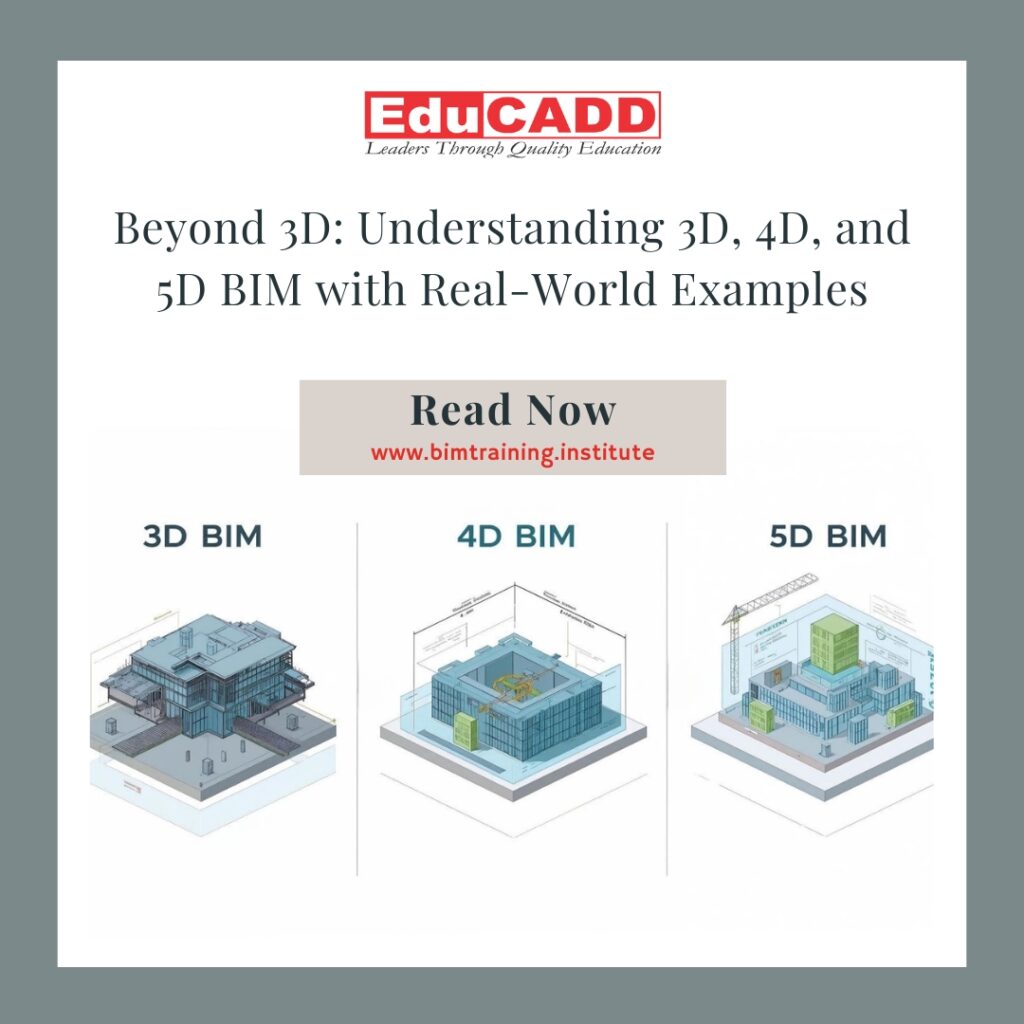
Although these terms sound technical, the concept behind them is straightforward. Each “dimension” adds a new layer of intelligence to a digital building model. 3D BIM focuses on visualization. 4D BIM integrates time. 5D BIM connects cost. Together, they create a powerful system that improves collaboration, reduces risk, and enhances decision-making. This article explains each dimension in depth, with practical examples and real-world applications, so you can fully understand how BIM reshapes construction workflows.
1. What is BIM and Why It Matters Today
Before diving into dimensions, it is essential to understand what BIM truly represents. BIM is not just a 3D model; it is a process that integrates structured information into a digital representation of a building. Every element inside a BIM model contains data. Walls include material specifications, beams include structural properties, and doors include manufacturer details.
Unlike CAD drawings, which show geometry only, 3D 4D 5D BIM connects geometry with information. Therefore, teams can analyze performance, detect clashes, calculate quantities, and simulate construction processes. Because data stays centralized, collaboration becomes smoother across disciplines.
As projects grow more complex, stakeholders require better coordination. BIM solves coordination issues by allowing architects, engineers, and contractors to work within a shared digital environment. Consequently, errors reduce significantly before construction even begins.
2. Understanding 3D BIM: The Foundation of Intelligent Modeling
3D BIM forms the core of all advanced BIM processes. It represents a digital three-dimensional model of a building, including architectural, structural, and MEP (Mechanical, Electrical, Plumbing) components.
In 3D BIM, every object exists as an intelligent element. For example, a wall is not just lines; it has thickness, height, material type, and structural properties. When you modify one part of the model, related elements update automatically. This parametric behavior improves accuracy and consistency.
Because teams can visualize the entire project in 3D space, they identify clashes early. For instance, if a duct conflicts with a structural beam, the model highlights the issue instantly. As a result, design teams resolve problems before construction begins, saving time and money.
3. Real-World Example of 3D BIM in Action
Imagine a commercial office building project. During design development, the architectural team creates a detailed 3D BIM model that includes walls, floors, windows, and façade systems. Meanwhile, structural engineers develop a structural framework model, and MEP engineers add ductwork and piping systems.
Once these models integrate, the software performs clash detection. The system identifies a conflict between a plumbing line and a structural column. Instead of discovering this issue during construction, the team resolves it during the design stage.
Therefore, 3D BIM prevents costly on-site rework. It enhances communication because all stakeholders visualize the same digital environment. Moreover, project presentations become more impactful since clients can explore realistic renderings and walkthroughs.
4. Key Benefits of 3D BIM in Construction Projects
3D BIM offers several advantages that extend beyond visualization. First, it improves design accuracy. Because components are parametric, changes propagate automatically across drawings and schedules. This reduces inconsistencies.
Second, it enhances coordination. Multiple disciplines collaborate within a shared model environment. As a result, communication becomes transparent and structured.
Third, it supports quantity take-offs. Teams can extract material quantities directly from the model. Consequently, estimation accuracy improves significantly.
Finally, 3D BIM strengthens client confidence. Stakeholders understand design intent clearly when they see a fully detailed digital representation instead of flat drawings.
5. Moving Beyond Visualization: What is 4D BIM?
While 3D BIM focuses on geometry, 4D BIM introduces the dimension of time. In simple terms, 4D BIM links the 3D model with the project schedule.
Construction involves sequences and dependencies. Foundations must finish before structural framing begins. Electrical systems must install before ceiling closure. 4D BIM connects these tasks to corresponding model elements.
Because of this integration, teams can simulate the entire construction timeline visually. Instead of reviewing Gantt charts alone, stakeholders watch the building rise digitally, step by step.
6. How 4D BIM Improves Project Planning
4D BIM transforms scheduling from a static document into a dynamic visual simulation. Project managers connect scheduling software with the BIM model. Each construction activity corresponds to specific building components.
For example, when the schedule indicates slab casting on Day 20, the 4D simulation shows the slab appearing in the model at that exact stage. If delays occur, teams adjust the schedule and instantly see the impact on the entire project timeline.
Because visualization improves clarity, site teams understand sequencing better. Moreover, project managers detect potential bottlenecks before they happen. Therefore, 4D BIM enhances risk management and schedule reliability.
7. Practical Example of 4D BIM in Infrastructure Projects
Consider a metro rail station project. Construction requires careful coordination between excavation, structural works, platform installation, and MEP integration. With 4D BIM, the project team links each activity to the digital model.
When excavation begins, the model displays soil removal and foundation works sequentially. Next, structural columns appear in simulation according to the schedule. If heavy rainfall delays excavation, the team updates the timeline and observes the cascading effect on future tasks.
Through this proactive planning approach, decision-makers adjust resources effectively. Consequently, delays reduce and productivity improves.
8. Advantages of 4D BIM for Contractors and Developers
4D BIM offers substantial benefits across project stakeholders. Contractors gain better site planning capabilities. They allocate manpower and equipment more efficiently because sequencing becomes visually clear.
Developers gain improved transparency. They can monitor progress visually instead of relying only on reports. Investors also appreciate timeline simulations since they clarify completion forecasts.
Furthermore, safety planning improves. Teams analyze work zones and schedule overlaps before execution. By identifying potential hazards early, managers create safer construction environments.
9. Introducing 5D BIM: Integrating Cost with Design and Time
After adding geometry and time, the next logical step involves cost. 5D BIM integrates financial data into the BIM model. In this dimension, cost information connects directly to model elements and schedules.
When quantities change, cost estimates update automatically. For example, if the design team increases floor area, the model recalculates material quantities and adjusts budget forecasts instantly.
Therefore, 5D BIM enhances financial transparency and decision-making accuracy.
10. How 5D BIM Strengthens Cost Control
Traditional cost estimation often requires manual quantity extraction. This process consumes time and introduces human error. However, 5D BIM automates quantity take-offs directly from the model.
When estimators assign unit rates to materials, the system calculates total project cost dynamically. If design modifications occur, the cost impact appears immediately.
Because cost data connects with the schedule, cash flow forecasting also improves. Project managers track expenditure over time and compare it with planned budgets. Consequently, financial risks decrease significantly.
11. Real-World Example of 5D BIM in Residential Development
Imagine a high-rise residential project. During design optimization, architects decide to upgrade façade materials. Once they modify the material specifications inside the BIM model, the system recalculates façade area quantities.
Because cost parameters link to those materials, the 5D BIM model updates the overall project budget instantly. The developer reviews the cost increase and evaluates return on investment before approving the change.
This real-time cost insight allows smarter decisions. Instead of waiting for revised estimates, stakeholders receive immediate financial clarity.
12. Combined Impact of 3D 4D 5D BIM
When combined, 3D, 4D, and 5D BIM create a powerful integrated environment. 3D ensures design accuracy. 4D guarantees time optimization. 5D secures financial control.
Together, these dimensions reduce project uncertainty. Teams collaborate in real time, visualize sequences, and monitor budgets simultaneously. Because information remains centralized, communication gaps shrink.
Moreover, data-driven insights replace guesswork. Decision-makers evaluate design alternatives based on cost and schedule implications instantly. Therefore, integrated BIM improves overall project performance.
13. Common Challenges in Implementing Advanced BIM Dimensions
Despite its benefits, implementing 3D, 4D, and 5D BIM requires strategic planning. Organizations must invest in software, training, and standardized workflows.
Resistance to change often slows adoption. Many professionals feel comfortable with traditional methods. However, training programs and leadership support can accelerate transition.
Data management also plays a critical role. Teams must maintain accurate and structured information within the BIM environment. Without proper coordination standards, integration becomes complex.
Nevertheless, companies that commit to BIM implementation gain long-term competitive advantages.
14. The Future of BIM Dimensions in Construction
The evolution does not stop at 5D BIM. The industry already explores 6D BIM for sustainability and 7D BIM for facility management. However, mastering 3D, 4D, and 5D BIM remains the foundation for digital transformation.
As artificial intelligence and cloud collaboration expand, BIM models will become even more intelligent. Real-time analytics, predictive cost modeling, and automated scheduling will shape the future of construction.
Organizations that adopt advanced BIM processes today will lead tomorrow’s infrastructure landscape.
Conclusion
Understanding the difference between 3D 4D 5D BIM unlocks immense potential for construction professionals. 3D BIM improves visualization and coordination. 4D BIM enhances scheduling accuracy. 5D BIM strengthens cost control.
When these dimensions work together, projects achieve higher efficiency, lower risk, and better financial performance. Rather than treating BIM as just a modeling tool, forward-thinking companies use it as a strategic management system.
In a competitive and fast-evolving construction industry, embracing multi-dimensional BIM is no longer optional. It is essential for delivering projects on time, within budget, and with superior quality.